
Units and Centers
Quality Assurance Unit
The continuous development of education, particularly higher education, is a key priority for Egypt’s national development agenda. Enhancing the quality of education, raising its standards, and achieving internationally recognized levels of excellence are central to the state’s efforts to advance the education sector and promote the accreditation of higher education institutions.
In line with these efforts, each university establishes a Quality Assurance Center that operates as an administratively independent academic center under the supervision of the University President.
A Quality Assurance Unit is also established in each faculty or institute within the university. The Unit serves as the faculty-level branch of the University’s Quality Assurance Center and operates as an independent academic unit. Administratively, it reports to the Dean of the Faculty, while technically, it is affiliated with the University Quality Assurance Center.
The Unit is responsible for supporting the faculty’s continuous quality improvement efforts and contributing to the development of its academic and administrative practices in accordance with national quality assurance and accreditation standards.
E-Services Unit
As part of the ICTP’s efforts to expand and activate information technology services and make them accessible to beneficiaries across university faculties—including students, faculty members, and administrative staff—the establishment of Information Technology Units within university faculties was initiated.
The ICTP aims to establish an E-Services Unit in all university faculties over the coming five years, through a phased implementation plan covering approximately 20% of the faculties at each university annually.
These units serve as a vital link between the six ICTP projects implemented at the university level and the individual faculties. In addition to enhancing the effectiveness and utilization of these projects—including the University Network, Management Information Systems, Training, the Digital Library, E-Learning, and the Digital Portal—the E-Services Units are responsible for providing high-quality information technology services tailored to the needs of the faculties.
Through these efforts, the E-Services Units contribute to supporting digital transformation, improving the efficiency of academic and administrative processes, and promoting the effective use of information technology across the university.
Seed Production Unit
Under the Patronage of:
- Prof. Dr. Hassan El-Nomani – President of Sohag University
- Prof. Dr. Khalaf Ali Hammam – Dean of the Faculty of Agriculture
Supervision:
- Dr. Mohamed Helmy Metwally
- Dr. Safwat Shalaby Abdullah
Animal and Poultry Production Unit
The Unit raises rabbits, poultry, sheep, cattle, and buffalo to provide red and white meat, as well as table eggs, for university employees and the local community in Sohag.
Food and Dairy Industries Unit
The Food Processing Unit was established in 2008 as part of the Faculty’s production units, joining the other productive units operating within the Faculty.
The Unit represents one of the Department’s key practical activities. In addition to its role as a production unit, it also serves as a training and research facility, providing students with practical training opportunities and supporting research activities in the field of food processing.
In line with the mission of the Faculty of Agriculture, Sohag University, the Unit applies sound food processing and safety practices to produce high-quality products without the addition of preservatives.
Main Products of the Food Science Department
The Food Science Department produces a variety of food products, including:
Frozen falafel (ta’meya)
Pickled lemon
Pickled olives
Strawberry and orange jam
A variety of baked goods and confectionery
Different types of pickles
Main Products of the Dairy Department
The Dairy Department produces a range of traditional and dairy-based products, including:
Domiati cheese
Cottage cheese (Qareesh)
Yogurt
Rice pudding
Mahalabia (milk pudding)
Horticulture Unit
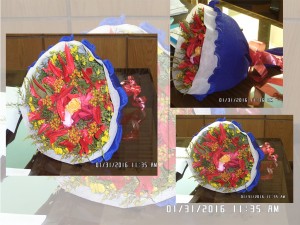
The Unit produces a variety of vegetable crops, fruit crops, and ornamental plants, as well as creating a range of flower bouquets and floral arrangements.
One of the ornamental products produced at the Faculty Farm in Al-Kawamel.
Design: Mr. Hamdy Gamal Riad
Bee and Silkworm Production and Breeding Unit
In line with a forward-looking vision based on sound scientific principles and modern approaches, the Unit seeks to contribute to the sustainable development of Sohag Governorate and support its growing potential in agriculture, investment, and rural development.
Sohag’s strategic location and the ongoing development of the Sohag–Red Sea Road are expected to create significant opportunities for agricultural development in the region, including new agricultural and agro-industrial projects, the establishment of new communities, and the creation of diverse employment opportunities for young graduates.
Since its establishment in 2000, the Unit has worked to develop a sound and scientifically based approach to production and development, taking into consideration the ongoing changes and emerging needs of the region. This approach aims to support sustainable development and help ensure that future agricultural development is carefully planned and effectively managed.
Under the Patronage of
- Prof. Dr. Hassan El-Nomani – President of Sohag University
- Prof. Dr. Khalaf Ali Hammam – Dean of the Faculty of Agriculture
- Prof. Dr. Ahmed Salam – Head of the Department
Supervision
- Prof. Dr. Nagah Sayed Mohamed Omran – Professor of Apiculture and Sericulture
Soil and Water Research Technical Services Unit
The Soil and Water Research Technical Services Unit aims to:
Prepare highly qualified agricultural professionals who meet the needs of the labor market.
Address challenges related to the reclamation and cultivation of newly reclaimed lands based on sound scientific principles.
Enhance agricultural productivity and provide technical consultancy services to farmers and agricultural companies.
Contribute to sustainable development and the protection of the agricultural environment.
The Unit provides a wide range of laboratory analyses using advanced equipment, including Atomic Absorption Spectrophotometers and Flame Photometers.
First: Soil Analyses
Determination of soil texture, structure, and organic matter content.
Measurement of soil salinity and pH.
Determination of macro- and micronutrients and cation exchange capacity (CEC).
Analysis of heavy and toxic elements, such as lead and cadmium.
Second: Plant and Water Analyses
Plant Analysis:
Determination of the plant’s content of essential macro- and micronutrients.
Water Analysis:
Assessment of water suitability for irrigation and determination of salinity and boron levels.
Extension and Training Unit
One of the key approaches to achieving the objectives of the Extension and Training Unit in community development and service is to assess the current conditions within the community, identify the problems arising from these conditions, and determine the Unit’s role in bringing about the desired change. In this regard, the Unit undertakes a number of key roles, including:
Acting as a catalyst, initiator, and facilitator of change.
Identifying challenges and developing proposed solutions to support the change process.
Assisting in addressing problems arising from the implementation of change.
Establishing effective links among the stakeholders and resources involved in the change process.
Monitoring the implementation of programs and evaluating their outcomes.
Unit Activities
- Training in all aspects of agriculture, including preparation, production, and marketing.
- Identifying and prioritizing key issues that require attention.
- Addressing selected issues related to rural women, rural youth, and rural leadership.
- Addressing various aspects of family life and the rural household.
- Promoting awareness of rural environmental resources and public affairs.
- Providing information and ensuring its continuous flow to those who need it.